
For engineers, manufacturers and procurement teams, sourcing copper and aluminium is rarely as simple as finding a material in the right thickness or section.
Material grade, tolerances, conductivity, finish, machining requirements, batch consistency and lead time can all influence whether a component performs as intended and arrives ready for production.
When specifications become more demanding, the supplier becomes part of the engineering and procurement process.
That is where working with a specialist UK copper supplier and aluminium supplier can make a significant difference.
ILF Products supports customers requiring copper and aluminium products for industrial, electrical and manufacturing applications, combining material supply with specification-led processing, stockholding and manufacturing capabilities.
Whether the requirement involves copper sheet and plate, aluminium products, electrical busbars, machined components or repeat production quantities, choosing the right metals partner can reduce supply-chain risk and help keep projects moving.
Why Choosing the Right Copper and Aluminium Supplier Matters
Copper and aluminium are widely used across UK industry, but the requirements of one application can differ significantly from another.
A buyer sourcing copper for an electrical busbar, for example, will have different priorities from a manufacturer sourcing aluminium profiles for a structural assembly.
Price per kilogram is therefore only one part of the purchasing decision.
A capable specialist non-ferrous metals supplier should help customers consider factors such as:
- Material grade and condition
- Electrical and thermal performance
- Finished dimensions
- Dimensional tolerances
- Required quantities
- Machining and fabrication
- Surface finishes
- Certification and traceability
- Repeat-order requirements
- Stock availability
- Lead times
- Packaging and delivery requirements
For trade buyers, the objective is not simply to purchase metal. It is to source the correct material in a form that fits efficiently into the next stage of manufacturing.
Why Is Copper So Important to UK Industry?
Copper remains one of the most important engineering materials where electrical conductivity, thermal conductivity, formability and reliability are required.
Its combination of physical and electrical properties makes it suitable for applications ranging from electrical infrastructure to specialist industrial equipment.
Common Applications for Copper Products
Copper products are frequently specified for:
- Electrical busbars
- Switchgear and control panels
- Power distribution equipment
- EV charging infrastructure
- Renewable energy equipment
- Transformers and electrical assemblies
- Heat-transfer applications
- Industrial machinery
- Fabricated components
- Earthing and grounding systems
- General engineering
For electrical applications in particular, copper’s high conductivity allows significant current to be carried through relatively compact conductor dimensions.
This can be valuable where engineers need to balance current-carrying capacity with enclosure size, heat generation and available installation space.
Copper Sheet, Plate and Bar
Different product forms suit different manufacturing requirements.
Manufacturers use copper sheet and plate for fabricated parts, electrical components, shielding, heat-transfer applications and industrial assemblies.
Engineers often choose copper flat bar for electrical applications because they can cut, punch, drill, bend and machine it into purpose-built busbars and conductive components.
Working with a specialist supplier means buyers can source material with subsequent manufacturing requirements already in mind.
Why Do Manufacturers Choose Aluminium?
Aluminium offers a different combination of advantages.
Its low density helps engineers reduce weight, while its corrosion resistance, machinability and versatility support a wide range of engineering applications.
Common Applications for Aluminium
Aluminium is widely used in:
- Industrial machinery
- Electrical enclosures
- Equipment frames
- Transport systems
- Renewable energy installations
- Construction products
- Heat-management systems
- Automation equipment
- Manufacturing assemblies
- Extruded profiles
- Bespoke fabricated components
For manufacturers seeking to reduce component or assembly weight, aluminium can provide a particularly attractive alternative to heavier materials.
The correct alloy, temper and product form still need to be selected carefully.
Mechanical properties, machining behaviour, corrosion exposure, electrical requirements and fabrication processes should all be considered before an aluminium grade is specified.
When Are Custom Aluminium Extrusions the Right Choice?
For repeat manufacturing applications, custom aluminium extrusions can provide significant design and production advantages.
Extrusion allows aluminium to be produced with a consistent cross-sectional profile. This makes it possible to incorporate functional features directly into the section rather than producing every feature through secondary machining.
Depending on the application, an aluminium extrusion may incorporate:
- Mounting channels
- Screw ports
- Ribs
- Locating features
- Structural webs
- Cable-management features
- Heat-dissipation surfaces
- Assembly interfaces
Custom profiles can be particularly valuable when production volumes justify creating a section around the product rather than designing the product around standard metal stock.
However, engineers should assess tooling requirements, tolerances, alloy selection, minimum production quantities and secondary operations before committing to a bespoke profile.
A knowledgeable UK aluminium supplier can help ensure these manufacturing considerations are addressed early in the sourcing process.
Copper or Aluminium: Which Material Should You Specify?
There is no universal answer.
Copper and aluminium each provide advantages, and the correct choice depends on the technical and commercial requirements of the application.
Copper May Be Preferred When:
- High electrical conductivity is critical
- Space for the conductor is restricted
- High thermal conductivity is beneficial
- Compact electrical connections are required
- The jointing system has been designed specifically around copper
- Electrical performance takes priority over component weight
Aluminium May Be Preferred When:
- Reducing weight is important
- Larger conductor dimensions can be accommodated
- Material cost is a significant consideration
- Corrosion resistance is required in the intended environment
- A lightweight structural profile is needed
- Extrusion can simplify a component or assembly
For safety-critical and high-current applications, material selection should always form part of the complete engineering assessment.
Electrical load, temperature rise, fault conditions, mechanical loads, connections, coatings, environmental exposure and long-term operating conditions may all affect the final specification.
Why Precision Processing Matters
Buying the correct material grade is only the beginning.
Once copper or aluminium is incorporated into a manufactured component, dimensional accuracy becomes equally important.
A hole positioned incorrectly by a small amount can prevent alignment with adjoining equipment. An unsuitable bend radius may cause fitting problems. Poor edge finishing may create handling or insulation issues.
This is why trade buyers increasingly benefit from sourcing both the material and appropriate processing through a specialist supplier.
Depending on the component and specification, ILF Products’ supporting capabilities include:
- Cutting
- CNC machining
- Punching
- Bending
- Linishing
- Plating
- Component finishing
- Stockholding
Consolidating these processes can help reduce the number of separate suppliers involved in a project and provide a clearer route from raw material to a production-ready component.
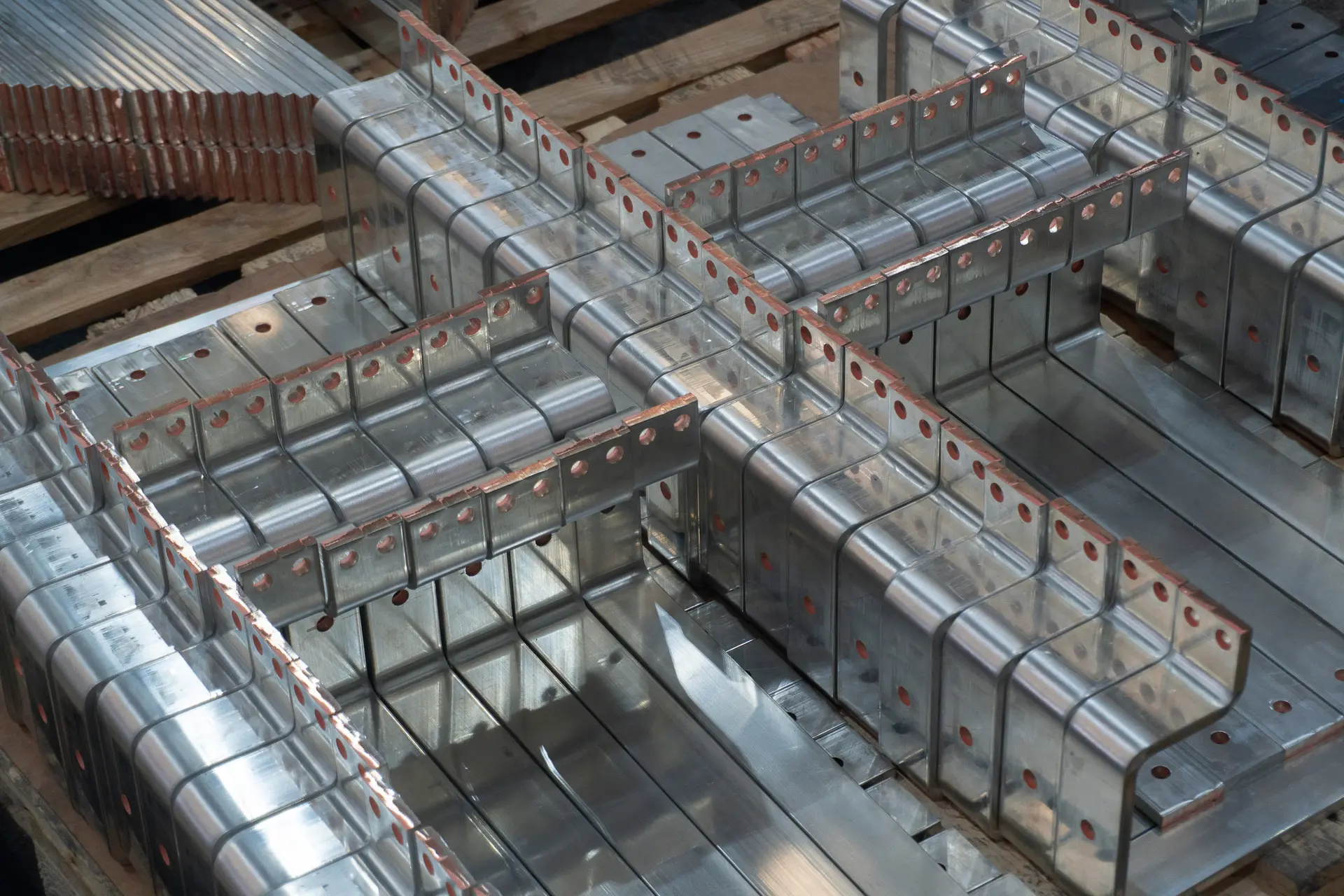
Copper and Aluminium Busbars for Electrical Applications
One area where material quality and manufacturing precision are particularly important is busbar production.
Copper and aluminium busbars provide defined conductive paths between electrical components and assemblies.
They may be used in:
- Switchgear
- Power distribution equipment
- EV charging systems
- Battery energy storage systems
- Power conversion equipment
- Renewable energy installations
- Industrial control equipment
- Electrical cabinets
- Data infrastructure
- High-current power systems
A busbar specification may need to define much more than overall width, thickness and length.
Engineers may also need to specify:
- Material grade
- Hole and slot positions
- Bend locations
- Bend angles and radii
- Dimensional tolerances
- Contact areas
- Edge requirements
- Plating
- Insulation
- Surface treatments
- Inspection requirements
- Drawing revision
- Quantity and batch requirements
In high-current equipment, dimensional accuracy also supports reliable assembly and consistent electrical connections.
A specialist copper busbar manufacturer and supplier can manufacture components to the customer’s approved drawings and dimensional requirements while maintaining control over the production process.
Why UK Stockholding Can Strengthen Your Supply Chain
Lead time is now a major consideration for many procurement teams.
A technically perfect material specification offers little value if components cannot arrive when production needs them.
Working with a UK copper and aluminium supplier that supports stockholding can provide several practical advantages.
More Predictable Procurement
Stockholding can help businesses plan repeat requirements without relying entirely on long international replenishment cycles.
Faster Response to Production Demand
Where suitable material is available, domestic stock can improve responsiveness when customers need additional quantities or replacement components.
Easier Repeat Ordering
For established components, combining agreed specifications with planned stock requirements can simplify subsequent purchasing.
Reduced Supplier Complexity
Procurement teams can simplify the supply chain by sourcing material, cutting, machining, fabrication and finishing through one specialist supplier.
Availability will always depend on the specific material, grade, dimensions, quantity and manufacturing requirements, so buyers should discuss anticipated demand as early as possible.
What Should Procurement Teams Include in an RFQ?
The more complete the information provided at quotation stage, the easier it is for a supplier to assess the requirement accurately.
When requesting a quotation for copper or aluminium products, consider including:
- Material type
- Required grade or specification
- Temper or condition where applicable
- Finished dimensions
- Quantity
- Technical drawing
- Dimensional tolerances
- Machining requirements
- Hole and slot details
- Bend information
- Surface finish
- Plating or coating requirements
- Inspection requirements
- Certification requirements
- Required delivery date
- Repeat or forecast annual volumes
Where a drawing is supplied, revision control is also important. Both the customer and manufacturer should be working from the correct approved version.
Providing this information from the start can reduce unnecessary clarification, improve quotation accuracy and help avoid specification issues later in the project.
Quality and Consistency Matter as Much as Price
For manufacturers, the lowest initial material price does not always produce the lowest total cost.
A component that requires reworking, causes an assembly delay or arrives outside the agreed dimensional requirements can quickly become more expensive than the saving made during purchasing.
A strong supplier relationship should therefore be built around consistency as well as commercial competitiveness.
ILF Products operates an ISO 9001:2015 certified quality management system, supporting controlled processes for the manufacture and supply of customer requirements.
For trade customers, this focus on process control is particularly valuable where parts are purchased repeatedly or form part of a wider manufacturing programme.
The Value of Working With a Specialist Non-Ferrous Metals Supplier
General metal availability is only one part of effective procurement.
When requirements involve demanding dimensions, electrical applications, fabricated parts, unusual profiles or ongoing production, specialist knowledge becomes increasingly important.
A capable supplier can help customers move from:
Raw material requirement -> specification review -> processing -> finishing -> inspection -> repeat supply
This integrated approach can be particularly useful to procurement managers who want fewer supply-chain interfaces and engineers who need components manufactured to clearly defined requirements.
It also encourages important questions to be addressed before production rather than after material has already been ordered.
Why Choose a UK-Based Copper and Aluminium Specialist?
Working with a UK supplier can provide practical benefits beyond geographical convenience.
For engineering and manufacturing businesses, these can include:
- Direct communication with an experienced supplier
- Easier discussion of drawings and specifications
- Access to UK stockholding
- Support for prototypes and repeat requirements
- Reduced reliance on complex international supply routes
- Better coordination of machining and finishing operations
- Greater visibility over production requirements
- Responsive quotation and technical discussions
The biggest benefit is often communication.
When specifications are complex, being able to discuss the application, drawing, tolerances and manufacturing requirements with a specialist team can prevent expensive misunderstandings.
Choosing Your Next Copper or Aluminium Supplier
The right supplier should offer more than a catalogue of available metals.
Engineers, manufacturers and procurement professionals benefit from supply partners who combine material expertise, manufacturing capability, quality control and application knowledge.
Whether you require copper sheet and plate, copper busbars, aluminium products, custom aluminium extrusions or precision-manufactured non-ferrous metal components, the sourcing process should begin with a clear specification and a supplier capable of understanding it.
ILF Products combines specialist copper and aluminium supply with UK stockholding and manufacturing capabilities for customers requiring reliable, specification-led solutions.
Need Copper or Aluminium for Your Next Project?
If you are sourcing copper or aluminium for a new design, production requirement or repeat order, speak to the ILF Products team.
Send your drawings, material specifications, quantities and required delivery information to allow the team to review your requirement and prepare a quotation.
Request a quote from ILF Products today and discuss your copper, aluminium, busbar or precision-manufactured component requirements with a specialist UK supplier.